Set up basketball group brackets
Use group brackets when one shared round robin would be too long, or when the competition starts in divisions, pools, or flights, such as school clusters, company divisions, or academy skill pools.
Before you start
- Read Choose a competition format for how groups, crossover, and qualification work.
- Create the teams and confirm they play basketball.
Set up the groups
Create the league
Select Create league > Customized. In League, choose Basketball, set Max Teams to the intended field (16 or 32), and set season dates wide enough for the game count.
Turn on group brackets
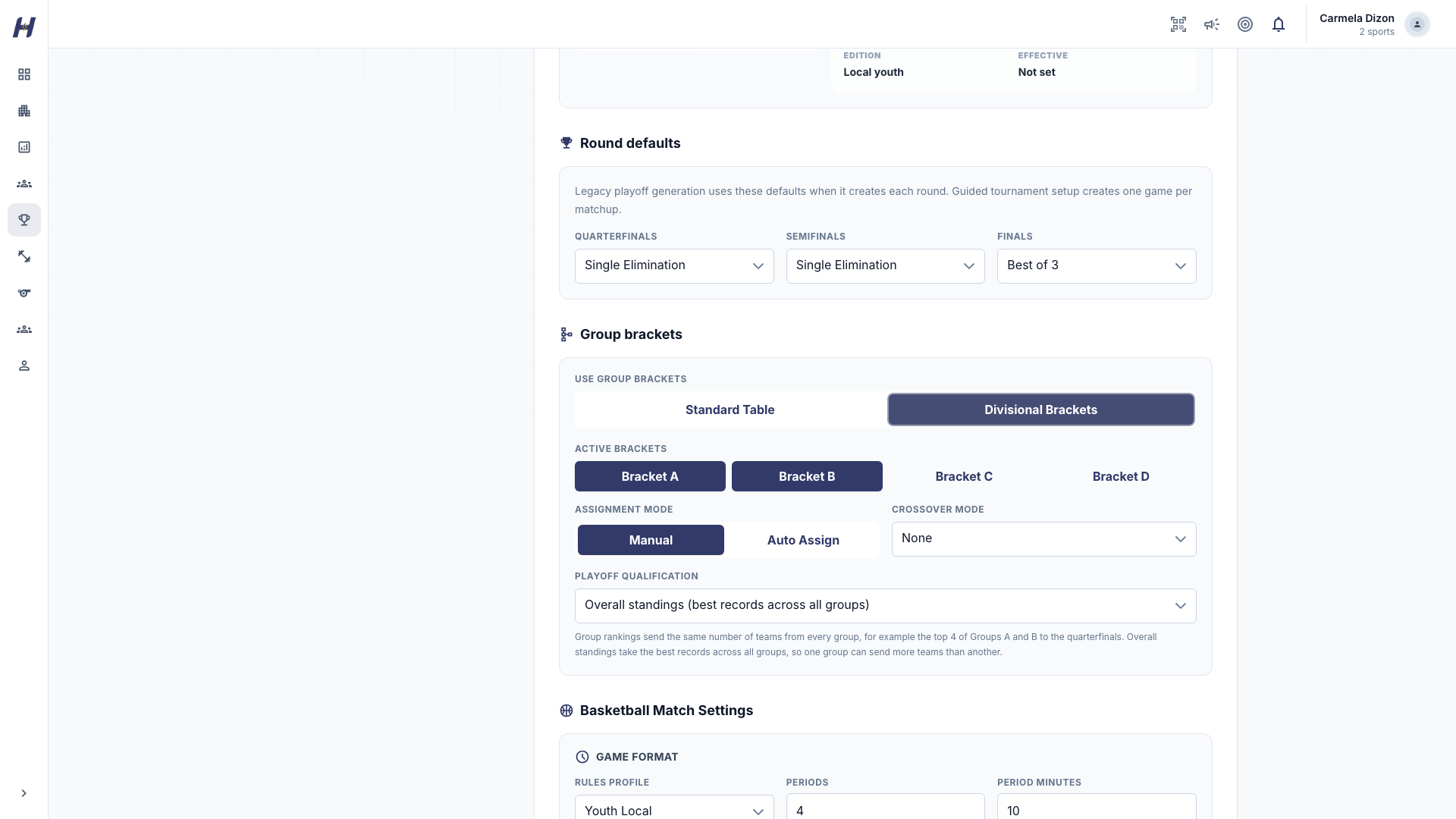
In Format, under Use group brackets, choose Divisional Brackets. Then set:
| Setting | What it controls |
|---|---|
| Active Brackets | Which group codes exist, from A to D |
| Assignment Mode | Manual placement or Auto Assign |
| Crossover Mode | None, Playoffs, or Classification |
| Playoff Qualification | With None: group rankings (top teams of each group) or overall standings |
| Seeding Strategy | How Auto Assign spreads teams |
Assign teams to groups
After saving, confirm enrollment and admission in Teams & Players. Open Matchmaking > Advanced Setup and use Put teams in groups: choose each team's group, set an optional seed, and select Save Groups. Group assignments lock once group games are generated, so check every team first.
Generate group games
In Advanced Setup, generate the bracket schedule. This is separate from the guided Everyone plays everyone flow. HustlX creates round-robin draft games for each group, plus crossover or classification placeholders when crossover is on and groups can be paired. Review everything in Manage Matches before publishing.
What you should see in Structure
After group games are saved, open Matches > Structure or Full Structure. A Group A game in round 1 appears as:
Group A > Bracket Round > Round 1
Northside Wolves vs Manila Archers
Organizers see drafts; the public sees a game after it is published. A manually added Regular game goes into a group round when both teams belong to the same active group:
| Manual game | Team groups | Where it appears |
|---|---|---|
| Northside Wolves vs Manila Archers | Both in Group A | Under Group A |
| Northside Wolves vs East Bay Titans | Group A vs Group B | A cross-group game, not in either group's rounds |
A cross-group game that is part of advancement belongs in the crossover or competition-stage workflow.
Example: 16 teams, four groups, top two per group
Four groups of four produce 24 single-round-robin group games, with three group games per team. After every group game concludes, the top two in each group qualify for an eight-team quarterfinal.
- Set active groups to A, B, C, and D.
- Choose Crossover Mode: None and Playoff Qualification: Group rankings.
- Set Quarterfinal pairing, save the setup, and publish the policy before group play.
- After the group stage, open Matchmaking > Advanced Setup > Auto-Generate and choose Quarterfinals.
- Review the pairing choice and the same eight group qualifiers before generating draft matches.
| Choice | Quarterfinals | Semifinals |
|---|---|---|
| Group crossover (recommended) | QF1 A1 vs B2; QF2 C1 vs D2; QF3 B1 vs A2; QF4 D1 vs C2 | Winner QF1 vs Winner QF2; Winner QF3 vs Winner QF4 |
| Overall seeding of qualified teams | QF1 #1 vs #8; QF2 #4 vs #5; QF3 #2 vs #7; QF4 #3 vs #6 | Winner QF1 vs Winner QF2; Winner QF3 vs Winner QF4 |
In the second choice, seeds #1 to #8 belong only to A1/A2, B1/B2, C1/C2, and D1/D2, ordered by the final overall standings. A third-place group team does not replace a runner-up even if it has a better overall record. Same-group quarterfinal rematches are possible.
This direct quarterfinal pairing is separate from Crossover Mode: Playoffs, which creates its own crossover stage and advances its winners. For either pairing choice, later rounds pair the winners of adjacent bracket games (the QF1 winner plays the QF2 winner), including the authoritative series winner, without reseeding standings. You can reorder teams on the Advance page before you generate a round. A league that already has quarterfinals advances by the bracket as drawn.
Example 1: 16 teams, 2 groups
| Detail | Example |
|---|---|
| Groups | A and B, 8 teams each |
| Group play | Single round robin: 2 x 28 = 56 games |
| Crossover | A1 vs B2, B1 vs A2 |
Set active brackets to A and B, choose Manual if you want to balance known strong teams, and choose crossover mode Playoffs. After group games conclude, HustlX fills the placeholders from the final group standings. Check them before publishing the crossover games. With Playoffs, the crossover game is a knockout: winners move on whatever their group record.
Example 2: 32 teams, 4 groups
| Detail | Example |
|---|---|
| Groups | A, B, C, and D, 8 teams each |
| Group play | Single round robin: 4 x 28 = 112 games |
| Crossover | A1 vs B2, B1 vs A2, C1 vs D2, D1 vs C2 |
Each team plays 7 group games instead of 31 in a full round robin. This is the easiest large-field setup to staff. Use Auto Assign only when automatic group placement is available for your organization.
Example 3: 32 teams, 2 groups
Two groups of 16 produce 2 x 120 = 240 group games. Use this only for a long season with enough courts, weekends, and table crews. For most 32-team leagues, four groups are easier to run.
Example 4: Repechage placement
In an 8-team repechage, quarterfinal losers play a placement path instead of going home, while winners continue toward the title. Open Matchmaking > Advanced Setup, choose the repechage template (single_elim_repechage_8) in the knockout phase tools, generate it, and confirm both paths in Full Structure. Repechage is a placement or second-chance route, not full double elimination.
Classification: the two orders can differ
With crossover mode Classification, choose the Playoff Qualification Source. If the final overall standings read Northside, East Bay, Manila, Makati, but the placement games produce Northside, Manila, East Bay, Makati:
- Final overall standings (recommended) (
overall_standings) seeds Northside vs Makati and East Bay vs Manila. - Classification placements (
classification_placements) seeds Northside vs Makati and Manila vs East Bay, with Manila as seed #2.
Neither option is a universal basketball rule. Publish your tournament's rule before play and complete the whole classification stage for either choice. Later rounds advance the winners of the preceding playoff games.
Checklist before publishing
- Every team is in exactly one active group, and group sizes are intentional.
- Crossover mode matches your league rules, and coaches understand how teams advance.
- Draft games have realistic dates, venues, and crew coverage.
Troubleshooting missing group games
If a saved game is not under a group in Structure:
- Confirm Divisional Brackets is on and the group is still active.
- Confirm both teams were saved to the same group in Advanced Setup.
- For a manual game, confirm its type is Regular.
- Reload Structure. On the public page, publish the draft first.
- If the teams are in different groups, treat it as a crossover or later-stage game.